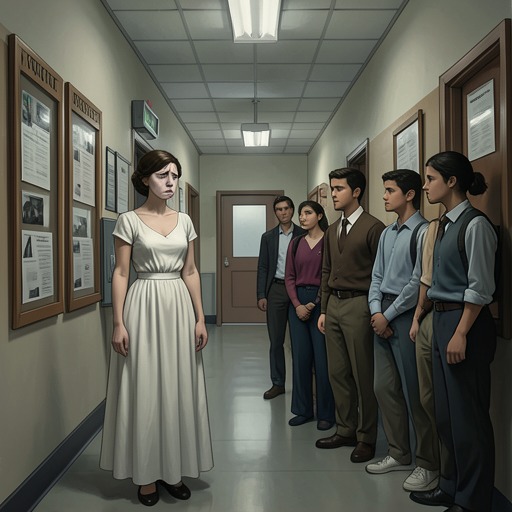
Jennifer Rockwell–Phyllida Trounce
Night TrainJennifer Rockwell–Phyllida Trounce is a relationship whose surviving outline is brief but consequential: the women shared a household at CSU, drifted apart after graduation, and met again shortly before Jennifer’s death. That last visit makes an old college connection part of Mike Hoolihan’s inquiry, but the account never establishes that Phyllida or her home caused Jennifer’s suicide. The distinction between a confirmed meeting and an unknowable motive gives their reunion its weight.
College Household and Shared Time
At CSU, Jennifer and Phyllida roomed together in a house with two other women. The available account identifies them as roommates and places their lives in a shared student household, but gives no detailed record of their domestic routines or the precise character of their friendship. Their connection is therefore grounded in a concrete arrangement—living together among a small group of women—rather than in a narrated catalogue of confidences or disputes.
The story later confirms that Phyllida had been ill during their university years. Mike recalls that she stayed until graduation, and Phyllida’s brief answer confirms the effort involved: she hung on. The remark offers a small, hard-edged measure of that period without naming her illness, describing its treatment, or claiming that Jennifer cared for her. It establishes that their shared time included Phyllida’s struggle to remain at university, while leaving the details of how the roommates experienced that struggle unstated.
Separation and the Residue of Contact
After graduation, Jennifer and Phyllida lost touch. Their connection did not end in a single reported quarrel or decisive break: they wrote to each other for a time, then communication faded. Phyllida explains the distance partly through her own habits, saying that she was not one for going out. The account does not describe the letters’ contents or say who stopped writing first, so the separation remains a gradual thinning of contact rather than a fully explained estrangement.
That limited history matters because it sets the conditions for the later reunion. Jennifer and Phyllida were not presented as continuously close, yet they had enough shared past for Jennifer to seek her out years later. The story makes no claim that the visit restored their former intimacy; it establishes only that Jennifer went to see her, and that the visit took place in the week before she died. A relationship can thus remain consequential without being continuously active: an old connection becomes newly important when the investigation asks where Jennifer went and whom she saw.
The Visit Before Jennifer’s Death
Mike’s questions establish the visit in stages. He first checks the college history, then the loss of contact, and finally whether Jennifer came to Phyllida’s house shortly before her death. After a pronounced pause, Phyllida confirms that Jennifer visited on the Thursday before she died. The weekday is the firm chronological detail the scene supplies; it does not give the visit’s duration, its purpose, or the substance of their conversation.
The setting sharpens the scene without resolving it. The house in the Crescent is cold and muffled with dust. Phyllida sits upright in a chair, her thin, weak brown hair and distant gaze contributing to Mike’s impression of stillness. A man wearing earphones is also present, silent and turned away from the interview; Phyllida’s stepmother can be heard moving and groaning in another room, though Mike does not see her. These observations describe the circumstances in which Phyllida answers, not what Jennifer experienced during her earlier visit or what passed between the two women.
Mike’s own response shows how quickly an investigator can convert proximity into a theory. As Phyllida pauses, he privately decides that he knows why Jennifer killed herself: she had set foot in this house. Her confirmation that the visit occurred verifies a meeting, not Mike’s proposed explanation. The narrative keeps those propositions separate. Phyllida’s home and Jennifer’s presence there become part of the timeline, but the scene supplies no evidence that the visit caused the death or reveals Jennifer’s purpose in coming.
What the Relationship Can and Cannot Explain
The narrative presents this friendship through fragments: a shared student household, an illness endured through graduation, a period of letters, a loss of contact, and one final visit. Its gaps are not filled with invented reconciliation or conflict. Phyllida’s pauses, rendered by Mike as unusually long, make the interview slow and difficult; they register the strain of obtaining an answer but do not disclose what Phyllida is thinking or why she hesitates. The scene’s restraint leaves the emotional meaning of the visit unresolved.
That uncertainty contrasts with the much more extensive surviving record Mike finds of Jennifer’s relationship with Trader Faulkner: albums and bundles of letters that trace years of their shared history. No comparable archive of Jennifer and Phyllida’s friendship is presented. The contrast concerns what the investigation can read, not necessarily the depth of either bond. For Phyllida, the available evidence is testimony, memory, and the verified Thursday visit; it cannot turn an old friendship into a complete account of Jennifer’s last days.
The relationship therefore serves the investigation without becoming its answer. Phyllida connects Jennifer’s university past to the final week of her life, and her confirmation gives Mike a precise point in the chronology. But the information remains narrower than the question Mike wants it to settle. Their connection establishes that Jennifer returned to someone from an earlier chapter of her life; it does not make her motive knowable.